Saturday, February 19, 2011

The Song that doesn't End.

I tinker with words constantly. I concoct silly puns, contradictions, oxymorons, and homonym plays--usually while running or driving--and record them with no real intention of using them. The results might emerge in a Facebook update or an occasional blog post, but the products mostly just sit on the pages of a journal in my book bag.

When I was an undergraduate, these pedantic little word games got me through long classes and literature seminars. I would string sentences or phrases together and think, That would be a cool band name. Or an album title, even. The writing picked up when I lived at home while completing my credential. I had more time then, so the work grew into larger bodies that actually had some miles. I paired my scribbling with a beginner guitar my brother loaned me, strummed the eight or so chords that Justin showed me, and started building "songs."

I kept my cards close, then. I didn't even play the stuff for my on again/off again college girlfriend (partly because I hated the sound, partly because the songs were not-so-subtly coded angst). I ponied up for cheap recording software and a new guitar. I sent files to Jamie and Justin, and eventually posted some work on Myspace. I made booklets and track listings for little "albums" in the living room with a coffee mug of wine. I painted the covers, drew on the discs, and gave them to my mom and stepmom.

Then and now, I know the work was completely self-serving. I often explained it as such, and excused myself from sharing because I didn't want to expose what I considered my own self-involvement. I didn't want to admit to the fact that, even if the outcome didn't make sonic or intellectual sense, it made me feel good. It helped me make sense of my departure from life on the central coast, a friendless, post-graduate slump, and life back in Placerville. It was lyrical, musical diary, really. It was my Post Secret--but with Myspace, there was a dash identity, and the thrill of imaginary audience.

I never performed my music for an actual audience, though. I played some songs over a cuppa wine on a number of occasions, usually at the request of Brittany and Sol. In the last couple of years, I've been pretty dormant, musically speaking, and don't mind much. I'm losing anything I ever had, to be honest. Whatever skills I developed evaporated; now, I find it hard to play more than three or four covers without cramping in the wrist and wincing at the pain in my fingers.

I still love words, but I use what I create differently these days, if at all. The Myspace page remains largely untended. From time to time it gets a visitor (and from time to time it's me, I confess). Once, last year, my brother in-law called me by my musical pseudonym. I got embarrassed.

This week, a wonderful student named Ivan stopped me as I returned some graded work. He said, "Mr. Petty, I heard a cool song this weekend." My gut flared a bit, but I suppressed it with doubt.

"Oh really, Ivan? That's cool." I saw the bait and swam away, turning to continue dispersing papers.

"Yeah. It's called, 'Stalkings.'" It's one of my tracks about someone who is obsessed with a girlfriend and suspects her of cheating. The speaker is hopelessly dependent, and stalks about town to find proof of his suspicions. That's stalkings, not stockings.

Like I said, word play.

So, the cat has destroyed the bag. Ivan looked guiltless. "Kelsey showed me," he said.

Ivan submitted his essay Tuesday. His properly formatted MLA heading read,
Ivan P--------
Mr. Petty / Kid Grin
Senior Lit. and Comp.
15 February 2011

Turns out, a lot of students know about this side of me, and no one really cares for an explanation despite my internal compulsion to offer one. It is what it is: a kid trying to make sense of his world on his terms. He's still connected to society (albeit virtually), but he's chugging along at his own speed.

I guess I can see why a 17 year-old would appreciate that in a teacher.

Sunday, February 13, 2011

My critical eye is closed, for now.

The two previous blogs were fairly ambitious. I engaged in some tertiary texts and made an argument or two--albeit creatively. I would likely classify those entries, if the necessity presented itself, as critical responses.

Enough of that, though.

While it has taken away the time and desire to build up the family blog in general, the writing I'm being asked to do in graduate classes is purely criticism. It is all argument, all the time. Thus far this semester, it has consisted of weekly prompt addresses (roughly three pages, on average), a response paper (nearly four), and the continual building of an MA thesis (stalling around page eight, currently).

Always, I am arguing.

Aside from the data spawning my thesis, my arguing is focused on the work of two distinctly prolific writers: Shakespeare and William Carlos Williams. Since enough has been said on the former--and since I'm slogging my way through an undergrad course to fulfill a requirement, let me address a few things about Mr. Williams.

The man is a machine (he often writes of cars and loved his typewriter, ironically). He wrote in all genres and forms throughout the span of his life, and did so while tending to and entertaining a family. Oh, and did I mention he was a full-time practicing pediatrician? He admits, in his quite funny and digestible autobiography, he'd typically come home late after work, head full of notes and thoughts, then bang out eight or ten pages before bed. It's somewhat frustrating to read of his nonchalance with this habit, actually.

If you're not familiar with Williams, as I wasn't upon registering for the course, you'll enjoy knowing he hung with a talented crowd. He did not leave with the other expats during the first War, though he visited them. He spent considerable time with Ezra Pound, Hilda Doolittle, E.E. Cummings, Gertrude Stein, and many others. He hated the fact that T.S. Eliot gave the poem "back to the academics," and considered his famous The Waste Land "[T]he great catastrophe to our letters."

If you do know Williams, hopefully you know more than the one about the wheel barrow, the one about the plums, or the one about the fire engine. If not, seek context. I beg you.

I enjoy where I find my head after reading his work, regardless of genre. There's play, humor, and ambition in the autobiography. The poetry and prose in his early books is a departure from the familiar. It's imaginative; his unabashed veracity, inspiring.

It's enough to be critical for the class. But here--here, there can be fun. Here's some of what I'm making from these thoughts.

River there placid,
friend to winter on
calm, clear, brisk
days of February--
Me here
on this levy
in jog, between
your stillness
and the workers flooding
the freeway, whose
rumble and
roll and
rhythm
have replaced you.

----
she has folded the magazine pages
back upon themselves to better
facilitate her reading--
the glossy stack curls from the
spine and creates
from this angle
the shape of a heart.
and the pages tell
the story of a
war.

----
in seeking the
poetics of the run i see
instead webs
fled by spiders
desiring simpler means
of survival. bound up
in rhythm too
s t e a d y
for word,
i submit

to be lost in breathing.

----
drowning steady hums
from fixtures in my kitchen
the teapot whistles

Sunday, January 30, 2011

Seeking the space to critique structuralism, I succumb to its pitfalls.

I agree, to a reasonable extent anyway, with the notion of rules and structures, at least as far as societal function and cultural facility are concerned. I do not prescribe to the notion that we're inherently good beings that, when left to our own devices, will consistently act in the best interest of what's dubiously dubbed "the common good" or "a brotherhood of man" [overt patriarchal language maintained intentionally]. I generally believe human beings habitually conceive of and impose structures to, essentially, grease the wheels of the masses. We regularly agree to stop at red lights, pay our taxes on time, and abstain from public flatulence because it works. We subscribe, unflinchingly often, that these kinds of rules exist for everyone's best interest.

Now, there are times when I knowingly disregard the pull of the structural tide. For example, rather than teach the "rules" of writing (read "grammar"), I advocate reading. My rationale is simple. I've seen too many students recite--in prompted chorus--that Sentences must have a subject and a verb and convey a complete thought, only to watch them grip their pencils and write a sentence like Except for when he learns Victor is his creator. Therefore, I direct them to books because I want their brains to get so used to the rules of language that I don't have to ask for choral responses. Rote memorization of these rules, in my and many researchers' eyes, never produced good writing. Really, I'm sneakily advocating from a kind of subliminal approach to structuralism, one that still teaches, but keeps me from overtly doling out oppressive language rules from my podium on Mount Pious (a term often used by this guy to criticize holier-than-thous atop soapboxes).

I'm belaboring the point of this post, which is actually both meaningful and perplexing.

I've had a frustrating week at the keyboard. Since last Sunday, after I went on my usual romp around my favorite pages on the interwebs, I've been hacking away with a huge monkey on my back. The weight has plagued me through typing simple emails, quick literary response papers, and even delayed the otherwise attractive immediacy of my Facebook postings. Thanks to Farhad Manjoo's article decrying the widespread acceptance of two spaces after terminal punctuation of a sentence, I've been afraid the grammar police will bust through my door any minute. "Can I let you in on a secret?" Manjoo begins from his powerful chair of knowledge. "Typing two spaces after a period is totally, completely, utterly, and inarguably wrong."

Hold the phone. Not that it's impossible to fathom, but he's essentially accusing my middle school computer class, high school keyboarding instructor, undergraduate technology lab professor, and instructions from a digitized Mavis Beacon as being misinformed. Can this be?

If personified, Manjoo's article would don black sunglasses, cross its arms, and gesture authoritatively toward a badge. It reeks of know-it-all. While he has his reasons--even noting that the Modern Language Association clarifies this rule in its yearly publication of humanities typographical norms--it's an abrasive read. And while I must concede his point, I desperately wish that I, like the rest of us habitually double tapping the spacebar after every finished thought, could have been let in on the development. Not for our own benefit, but to make Manjoo hate us less. His offense is, well, actually offensive. He bemoans our ignorance, upset by the fact that "people who use two spaces are everywhere, their ugly error crossing every social boundary of class, education, and taste."

Geez, man. We had no idea.

So, this week I've been working on cutting that second, quick thumb slap at the end of my sentences. I started a couple of paragraphs ago, in case you wanted to know. And it's not easy; my endless revision a la deletion has forced me to realize how ingrained typing is in my day to day operations. It makes me want to go outside, really. Or write a letter. Or avoid Slate.com for awhile.

Realistically, the article strengthened my resolve as a teacher. While I have conceded to try and adopt this single-space structure, I remain adamant in my stance that there's a lot of damage posed by this kind of tone with these kinds of rules. In my eyes, they don't inform so much as belittle. Disenfranchising is something I strive to avoid in my adult life since, in retrospect, I spent far too much time mastering the art of ostracizing others as a teenager.

So now, in my professional life, the pages I read will still look relatively normal even if the writer uses two spaces. And Manjoo? He will still hate the world.

Friday, January 21, 2011

Why I Love the Romantics (or, Why I Hate the Romantics)

Be through my lips to unawakened Earth

The trumpet of prophecy! O wind,
If Winter comes, can spring be far behind?

And it's now, fair reader, that I venture into waters heretofore uncharted. I admit I may lose you with this next sentence alone, but it's true: I've been snookered by the beauty of "Ode to the West Wind," by Percy Bysshe Shelley's terza rima, by his five sonnet ode to the Zephyrian gusts, and by his burning desire to, well, get blown.

You blacked out until blown, right? I can't say I blame you.

Before this week, I preferred not to tango with Romantic poetry. I happily ignored all things Wordsworth and Coleridge and Blake as soon as I, then a senior in high school, closed the massive anthology and opened Huxley's Brave New World. It's fitting, really. That "brave new world" I sought wasn't to be found in gushing naivete of a Romantic mysticism; the world I wanted was hurdling through the future, spinning off into distopian catastrophes, and stoking the fires of prophetic failures in a false social "order."

But today, I capped off a week of Romantic poems with my seniors through an examination of Shelley's ode. After four days, I finally got them to focus on how the aforementioned poets regarded nature and their relationships with it. I washed the poetic intricacies with suds of superficiality. I accepted the dumbed-down responses. I broke them of the wont to label these poets hippies, escapists, or just plain loony. They finally recognized my urgings, eventually reciting for me--in sloppy handwriting all--how speakers "want to be in harmony with nature," how the rationalism sent them "on journeys to make nature mysterious again," and how social order in the cities "made monsters of good people."

Then, I casually sent them back into the ugly world they inhabit, oblivious to an existence without artificial sounds, artificial light, and empty hands. Before one group of students left, I reflected on an assignment I used to mandate. For homework, I told them, I used to ask my students to seek out a location in a natural setting. There could be no traffic, I recalled, no music, and no cell phones. When students arrived, I just asked that they sit for 30 minutes. After that time passed, I only requested they write about their reaction to the previous chunk of time. I didn't assign this today, mind you, just invoked it as a hollow threat.

The gasps were overwhelming. The horror of disconnection, even for thirty minutes, seemed unfathomable to many of them. It forced me to wonder, If being a Romantic is no longer attainable for anyone who claims to have a soul, is merely understanding the Romantics, the circumstances that drove them to create, and the awareness of their appeal, also impossible?

When I got in my car and left, I received a partial answer:
"The answer, my friend, is blowing in the wind./ The answer is blowing in the wind."

Saturday, January 15, 2011

Race for Daylight.

Stephanie admitted possessing an unimaginable optimism at the prospect of running with the sun out. Such are the wants at the Zook/Petty house.

Before today, all we had to show was a whole lot of wanting. Since the marathon and the much-needed rest period that followed, we've been slowly getting back into a routine. I've joined the Fleet Feet racing team this year, and Stephanie has mapped out a semi-independent racing schedule of her own.  Preparing for racing and distance events again, for us at least, involves training in the dark. When given the chance to run friendlier times, we've been subjected to weekend runs marred by clouds, fog, and rain.

Initially, the weather didn't faze us. No longer training, we shared our excitement about not having to hit particular distances, not needing to complete tempo runs or adjust for pacing, and not even wear a watch if we felt so inclined (only I can cop to this, however). But with the increase in speed work, workouts involving splits and tempos, and overall mileage, we've struggled to absorb the added work alongside the relentless winter weather. Since Christmas, for example, I've felt compelled to add sleeves, gloves, and a hat to my ever-growing collection of gear. It helps the training, but the process of bundling up can force me to question the value of the time spent in the elements.

Today, despite the fact that fog swarmed the area around 9:45, we enjoyed an easy run on a parkway bathed in morning sunlight. We started from my new favorite location, the Bella Bru at Fair Oaks and Arden, and jogged to the trail entrance at William Pond. Steam rose from the river, cobwebs and tall grass glistened in splotchy orange shimmers, and my hands and head felt a necessary freedom outside their cold-weather protection.

The pace was smooth; I set out with other team members, conversing throughout at a pace around 8:15 per mile, while Stephanie held back and operated at a speed more conducive to her current workout schedule. I finished my 10 and returned to Bella Bru for a cup of coffee, paper marking, and a bran muffin. Stephanie returned not long after, having finished 12 miles of her own. We enjoyed a leisurely breakfast together amid a throng of gym goers, cyclists, and runners, and decided we'd definitely been missing out on the post-training culture that this part of east Sacramento has to offer.

It was a great way to spend a morning. By the time we left, the sun, much like our plans for exertion, had called it a day.

Saturday, January 1, 2011

Resolution Revolution.

I love opening the paper on New Year's Day and seeing all the gibberish about resolutions.  People plan to quit things, moderate things, alter hobbies, and regiment their lives.  Many of the stories seem recycled or tired, and much of the skimming I do really only clears the cerebral grogginess lingering from the previous night's champagne.

It's always easy to spot some of these resolvers.  I see them when I'm out running errands, sloshing through the mud and rain and wind in their new cross-training jackets and sleek fit caps.   They're crawling on gym equipment like ants at a campground, and they're draped in new apparel, looking perplexed as they read the instructions on the lat pull.

I was never one to set resolutions.  I suppose it's because they've always seemed so pie-in-the-sky.  I have to applaud people for setting goals, but those kinds of decisions don't really seem feasible or attainable for me.  In the last two years, however, I've realized something about New Year's resolutions.  If the decision is measurable and incremental--if it's marked by weekly or monthly deadlines--it not only serves as a resolution for the new year, but can become a habit far those that follow.

My 2009 Resolution (met):
In an effort to bridge the important pieces of my college life with my post-college life, I resolved that Stephanie and I would meet up with Brittany and Sol at least once a month for a meal and a visit.  We kept a steady schedule for the better part of eight months, enduring a wedding, honeymoon, and the holidays.  Toward the end of the year, we had to double up in a later month in order to make up for problems arising near the holidays, but we remained diligent and steadfast, refusing to let the idea fade.  We celebrated our final date on the first night of (what has become the annual party to celebrate) Hanukkah.  

My 2010 Resolution (also met):
Only five months into our marriage (though many more into our relationship), I started feeling guilty about my penchant for providing a predictable and unaltered dinner menu.  With a slew of new utensils, appliances, and cookbooks, I resolved to cook one new dish each month.  Joining me on this adventure, Stephanie decided to explore the variety of baking options at her disposal.

This was a fantastic resolution, and it only felt like a chore once or twice.  We faced some strain as the days dwindled in those longer summer months, or as we negotiated ambitious travel and hectic work schedules.  Trying to hand crank homemade pasta at 9:30 was no picnic (in fact it led to a drink or two); but overall, this was enjoyably manageable, and it directly affected how we shopped for and utilized food products in the house.  In fact, we shared our ambition with a number of friends, whether in the form of African stew in July, Thanksgiving pies, or spicy meatballs just two weeks ago.

The Resolution for 2011 (status uncertain):
The key to my success is the variety offered in month-to-month installments.  This year, I hope to plant one new item in the garden every time I turn the calendar page.  Inspired by this handy Sacramento Bee article, a bevy of unopened gardening books, and a bold family of trendsetting farmers, I'm hoping to begin harvesting seasonal fruits and vegetables very soon.  If this resolution pans out like the previous two, I'll hopefully find myself reflecting on a newly adopted habit well into 2012. 

Happy New Year out there!  Whatever you do this year, do it well.

Friday, December 31, 2010

The Difference Between Sitting and Standing.

We went south on December 27th.  Our Southern California agenda included a brief visit with my relatives, viewing a high school basketball game, and a trip to the Magic Kingdom.  We planned to return on Wednesday the 29th.  Here's how it all went down:

Sitting
Packed quite lightly, we set off for Claremont around 8:45 a.m.  The drive down Interstate 5 was largely uneventful.  The winter weather gave pause to an abundance of tule fog and splotchy clouds.  Most of the central state offered green, rolling hills, along with sardonic political signs blaming Congress for water shortages.  The Grapevine offered glimpses of snow and sunshine, and upon our descent into the definitive south, we were met with traffic.  I handled the wheel, while my wife intermittently slept in the passenger seat.

The traffic continued on the 210 East.  Our driving window missed the morning traffic, but apparently coincided with afternoon gridlock.  Stephanie and I saw the best of Pasadena, crawling along the freeway and discussing the merits of gift cards and shuffling through appropriately themed music (Death Cab for Cutie's "Why You'd Want to Live Here," The Decemberist's "Los Angeles, I'm Yours," and anything Gwen Stefani).  I complained about the discomfort of sitting and driving, and wondered aloud how we made it to South Africa on an airplane.

Standing
Claremont, if you are unfamiliar, is a quaint community east of Pasadena.  My uncle and aunt live there; both walk the quiet streets to their jobs at different Claremont colleges.  My uncle works at Harvey Mudd, where he's a professor of literature.  His wife works at Claremont Graduate University as a professor of religion.  Despite the fact that it mirrored their daily routine during the semester, they accommodated our seated travel with a brisk walk through parts of the campuses.  We settled at The Back Abbey, an awesome British pub with an intimidating burger menu and a stellar beer selection.  Between the rich conversation on Greece, fries cooked in duck fat, and a mean seasonal stout, we settled into a fine mood and warmed ourselves for a walk to the car and a quick jaunt to Orange.

With directions punched into the GPS, we navigated the highways towards Anaheim.  The lodging for the Jesuit High School basketball team was, we surmised, in Orange, the location of the tournament.  After walking into the wrong Hilton Suites and knocking on a few doors, we continued to Anaheim and settled at a Hilton near Disneyland.  Ben and the coaching staff hadn't yet eaten, so we made our way to a P.F. Chang's, where Steph and I enjoyed another beverage and chatted about the on-court happenings of the day.  We then made our way to Bar Louie in Anaheim Garden Walk for more of the same.

After some snoring, a groggy purchase of some park-hopper passes, and a breakfast buffet, we set off down South Harbor Boulevard in the brisk December sunshine.  We were warned of Monday's ticket sellout and admission cap for both theme parks, but we felt confident that if we arrived in the 8 o'clock hour we'd survive the rush.  We did, and got our first taste of fun on the Buzz Lightyear ride, where we slaughtered a number of aliens hellbent on eating batteries (I think that's the storyline, anyway).
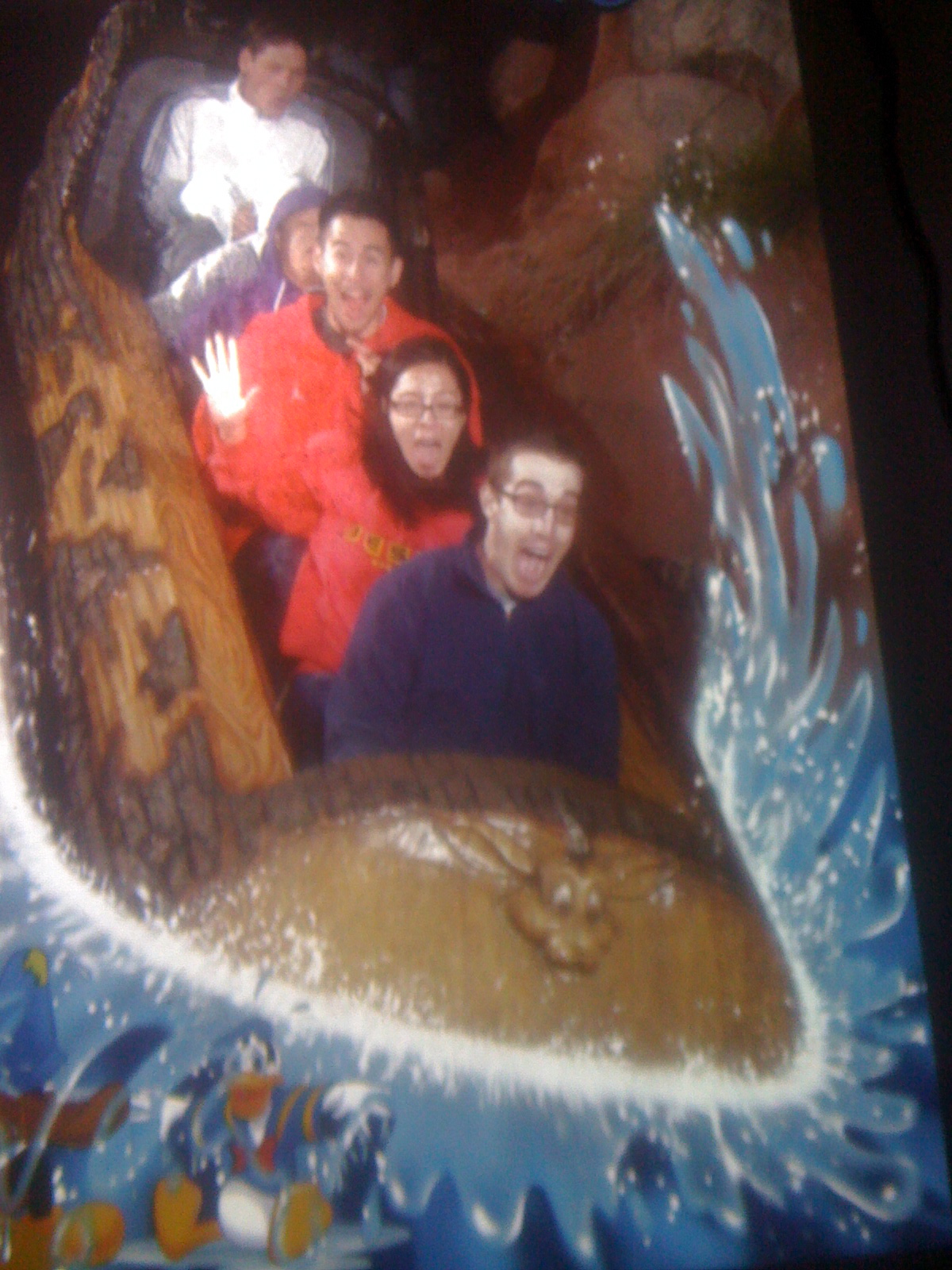
As the people piled in, we made our way to Pirates of the Caribbean, where the 40-minute wait felt like a breeze.  We failed to procure any fast pass tickets because of our plans to see Jesuit play in the middle of the afternoon.  From Pirate's, we hit Splash Mountain.  I won the competition for first-to-see-someone-you-know, and we all got drenched before heading to Big Thunder Mountain for 75 minutes of zig-zaggin and a 2.5 minute roller coaster.
After the train ride, Ben split to meet up with the team, while Stephanie and I entered California Adventure for a quick walk and some lunch.  After another 75-minute ordeal (for food, believe it or not), we walked (and ate) our way back toward the Hilton to prepare for the game.

Sitting
The tournament, held at Chapman University, included teams from across the state (and one from a town in Washington named Squalicum).  Tired but excited, Stephanie and I enjoyed some top-notch hoops as the Marauders drowned the Squalicum Storm in flurry of three pointers and quick, cutting layups.  We were impressed not only by the stamina of the high school kids enduring a holiday road trip, but also by Ben's poise, and the ability of the Chapman University snack bar to out-coffee the Hilton.

Standing
After the game, Ben, Stephanie, and I made our way toward a Subway sandwich shop and eventually a reentry into Disneyland.  We hadn't yet learned of our good fortune that day, but we certainly knew the park was a popular spot.  We pushed our way to the Indian Jones Adventure, waiting 80 minutes to drive the SUV through the temple.  We passed the time with a number of cell phone checks, app downloads, and memories of our shared time in South Africa.

The ride ended just in time for us to catch the fireworks spectacular.  Amid the throng of oohing, ahhing fans, we managed to find a nice spot beneath an obstructive tree and coo along with the masses.
Our plan was to beat the crowd back to Big Thunder Mountain, but our plan was thwarted.  First, the Disney traffic directors made it impossible to get from Main Street to Adventure Land.  Then once we finally herded ourselves toward the ride, we found it closed.  The Matterhorn offered nothing better, so we swallowed our evening and prepared for Space Mountain's 120-minute wait.

As 8:50 became 9:45, and 10:00 became 10:30, we passed the time by playing variations of the I'm-thinking-of-a-person game, a game that if correctly played, most definitely helps to pass the long, cold minutes of waiting.  This game was first played by us at SFO waiting for a flight to JFK (and then to Johannesburg).  We've gotten pretty good at passing the time together.  By 10:40, we'd made it indoors.  We wound our way through the interior walkway, desperately seeking a place to sit.  We were not disappointed.

Out of leg strength and out of time, we called it a day and headed back to the Hilton for some sack time.

Sitting
After another Hilton breakfast, we took the Prius back toward the highway for a long stretch of traveling.  We stopped in Buttonwillow, where it became clear that Denny's is a place for travelers, not just old people.  I grazed a tumbleweed or two on I5, never surpassed 75 mph, and returned safely to the cat that evening.