Thursday, June 30, 2011

Unraveling a Good Yarn.

More and more, I see life as a prolonged absorption. I consider where I've been, who I've seen, and what I've heard, and how it constructs who I am and what I think and believe. Time and retellings sometimes layer the stories and memories that build me with a glamorous dust of nostalgia, and if I'm not careful, I find myself soaking in sterile versions of an otherwise complex reality.

Absorption is natural. It's a process of construction akin to setting up a Jenga tower one block at a time. And self examination, self analysis really, requires a certain stock of vigilance in order to scrutinize the fundamental elements of one's personal makeup. It can be exhausting, frankly, and lead, like gaming the Jenga tower, to periodic toppling.

Unlike Jenga, however, the fallen blocks do not constitute a loss. Understanding this, over time I've made self examination and self analysis as natural as absorption. I've learned that these symbolic Jenga pieces can do a lot more than make and remake towers; however, I've also come to see that making self study second nature renders one a slave to process--a believer that knowing is ongoing, really.

With this prologue in mind, I submit my annual summertime musings on the father-son dynamic by which I'm so ardently intrigued. In past summers I've analyzed some father-son traditions, asked that my old man expose me to one part of his history, and even tried (failed, really) to walk in his footsteps. In keeping with this interest and tradition, this summer I asked Dad to help me discover more relics of our father-son dynamic by showing me elements from his own past, moments from his history that perhaps trickle down to inform our own.

I can't say for sure if this in some way fuels my own understanding of my relationship with him, but I know that learned behaviors reconstitute themselves over time, and I know I understand him--to some extent--because of the way he understands his own experience as a father and son. Like last year's backpacking trip, I again forced him to take the reins. This time, however, I challenged him with a less strenuous quest through his hunting history in Idaho.

Hunting, for my father as a child, was a learned behavior. He followed the lead of his own father, who had in his youth forged relationships with other men who enjoyed the practice. This enjoyment eventually took them to the northern regions of Idaho, a place where hills give way to sweeping valleys and dramatic canyons that offer a treasure of public and private lands teeming with deer, elk, sheep, and bear. My father's first trip into such country involved 12 hours in the back of a trailer, where at 13 he and his twin brother bickered and argued nearly the whole of a drive which culminated in two, long hours down a nauseating dirt road into Wild Horse Canyon.

After returned trips, a property owner in the canyon suggested she and her husband better "make friends with them California boys." And thus, what started as an invite for dinner forged a bond that outgrew its original intentions. The family eventually provided lodging and hospitality for countless hunting trips, and offered staging areas for various trips in the canyon and around their daughter's home in the community of Council. In exchange for this kindness, my grandfather provided tractor parts--his trade, really--along other necessities for the rugged, canyon living characteristic to this kind of country. The relationship eased the burden of isolated living for them, and provided relief from the burden of urban living for my family. Things evolved--continue to evolve really--into an extended family forged by fondness and frankness, bearing all the brightly and darkly shaded tones of tradition and time.

I've included some highlights of my recent trip, and brief explanations of particular threads comprising the familial flag.

The view west through Wild Horse Canyon, toward Council, Idaho.
The view of the ranch house from an overlook bearing family memorial plaques.
My father, addressing his dad's plaque, alongside current property owner Darryl. The ranch and land were passed on from his father-in-law Arnold, whose plaque sits in the foreground. Portions of both men's ashes were scattered from the hilltop.
The ranch house and seasonal garden (below).
Darryl (at right) making homemade ice cream in the kitchen/dining room.
The staircase to our lodgings.
My spread.
We took a dirt road out of Wild Horse, driving the ridge line toward popular hunting locations. This is a view from the rim of the canyon, looking northwest in the direction of Oregon state.
The view toward a tiny speck of the ranch house from the deer trail (below), trekked countless times by the men in my family.
Dad, indulging my desire to try the fast-moving Wild Horse River, tying the brightest spinner we have.
We wised up, finding far more success the next day. Here's the result of my first cast at Lost Lake, north of Council. The second and fourth casts provided the same result.
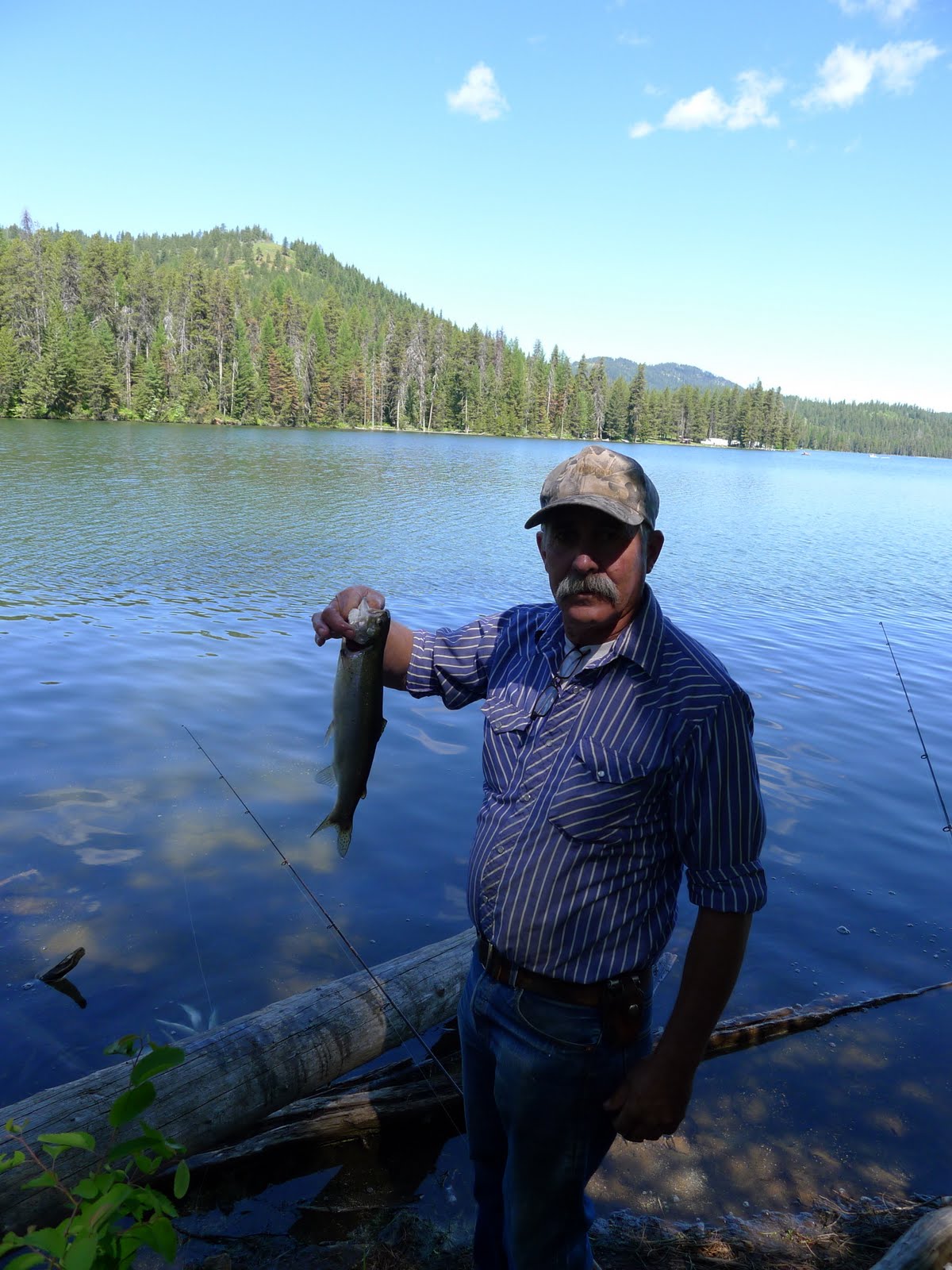
Uncle Ray shows off the day's dandy whopper.

Final tally came to 14, four shy of the limit. We threw a number of smaller perch back, but saved a few for what I'm told are tasty filets.
Ruth, the matriarch and initiator of the friendship "with them California boys," surveys the remnants of our fish fry back in Council.


For me this experience, like those in past summers, hasn't been about uncovering the past so much as using aspects of it to justify the future. Before the dinner we shared on our final night in Council, Ray made a brief whiskey toast at cocktail hour "to old times." The salute seemed fitting: he and my father, estranged step brothers, had just spent the afternoon casting line and telling stories. From Ray's left, with my own glass, I added, "and to new ones," in a hazy move to solidify the permanence of our unfurling lineage. He paused, considered, and agreed as the atmosphere seemed to turn momentarily poignant.

But a really good story will do that to you.

Monday, June 20, 2011

Sibling rivalry: When the TV Fights for a Place at the Table

I was fortunate enough to see my college roommate on Father's Day. This is significant for a number of reasons, but the most prominent include that facts that, a.) He was the first in my inner circle to become a father; b.) The opportunity to become a father ended our time together as roommates (rightfully so, we would say); and c.) I haven't seen him in at least a year.

He and his family live a stone's throw from my grandpa's house. Since the old man is a father worthy of celebration, I found myself chatting in the garden and realizing I should probably pay a visit. I walked over to his place and sipped on a gin and tonic, because I thought it would be funny to boast about the childless world of Sunday afternoon gin baths (kidding, sort of). I ended up catching the tail end of their family movie night, and showed up just in time to see a motley group of digitized, sub-Saharan animals walk off into the sequel to a Madagascan sunset.

"Is this a weekly occurrence?" I wondered.
"Pretty much," he replied. "We like that the television is in here. Usually its music or voices for their entertainment."

Here was a tiny alcove near the front door, probably conceived as a mudroom for shoes and coats. As I sat on the floor, the children bounced on a small loveseat and told me about their favorite scenes before scampering off into their own sunset, now just visible through the branches of a tree and the backyard swing.

I told my wife about this arrangement later that evening--about secluding the television in another room--and we discussed the nature of television in our childhood homes, as well as what we observed with our friends then and now. In my house, I told her, everyone got ready at their own speed, so spending my middle school mornings with Eek the Cat! was pretty common. My step-mom even coaxed my brother and me into submissive cereal sessions by using VHS episodes of Teenage Mutant Ninja Turtles we'd seen hundreds of times.

I was somewhat of a latchkey kid outside of football season, so I spent afternoons with Music Television staples like The Grind or Singled Out or, in earlier years, Fox's Mighty Morphing Power Rangers. When dinner was served or homework started, the TV finally went blank. It kicked back on later, and even put me to bed on occasion. I confessed to having, but not abusing, my own small TV set in my room at one house.

At certain friends' houses, both then and now, the TV is the chattiest member of the family. It's on even when no one's watching it. The steady beat of commercial jingles, conversations, and sportscasters fills any gap day-to-day living and communicating might create. Most often, the ubiquitous white noise of the television causes anxiety, confusion, or stress when eliminated. Things seem a bit awkward for them, likely the same kind of awkward I feel with the damn thing always on. The existing silence represents a lack which, like a junkie after that sweet warm glow, needs fixing.

In the interest of full disclosure, I will say that we have an enormous television set in our house. It is featured prominently in a central location. We have modern bells and whistles as well. There's a dusty Wii, the an unfilled 6-disc DVD player, and an old VCR. We also rely on the genius of TiVo to select and record programs, then zip through commercials that get in our way. While I might sound like a slave to entertainment, last night I realized something kind of neat. TiVo ensures that we know why we are sitting in front of the screen. No one sits down and says, "What's on?" It's only, "What do we have saved up?" or maybe an expectation of a regularly scheduled episode. When the show ends, so does our TV time. Because we select the shows we want to watch, we flip, surf, or endure programs in the hopes of finding something to watch. The TiVo, it seems, is a solid reason we don't feel compelled to let the tube prate on in the backgrounds of our evenings.

Though my life does not share the context or the structure of my old roommate's young family, I do not fear that someday my own clan, whatever shape it might become, will rely on a channel to fill the spaces between its members. I'm sure this imaginary family will have plenty to talk about as soon as Daddy figures out how to kick this internet habit...

Thursday, June 16, 2011

Call it, "A meditation on fantasy."

It's summer again, so I'm carving out a new routine.

I wake at the same early hour, somewhere before six. I open three windows, grab the newspaper, start the coffee, feed the cat. I usually head out for my run before 7; if I'm resting that day, I dig into the A section.

By mid morning, I'm at the keyboard, reading analysis and commentary on Slate or Grantland, updating newly downloaded podcasts, checking in on Facebook, and considering my errands and chores list.

Sometimes there's time for television, and since my usual cycle of watching only includes the staples I've made time for, summer represents my best chance to catch up on the nonsense I would otherwise skip in lieu of favorites like Community, Friday Night Lights, or Mad Men.

So, I've reacquainted myself with Anthony Bourdain and his No Reservations franchise, something I admitted to loving back in an early blog nearly three years ago. What I loved about the show, then and now, remains Bourdain's episodic commitment to spinning a food-centrist narrative. All the ills plaguing social and cultural landscape of the Western world--one might gather in watching Bourdain's the carefully-constructed arduousness of his trek across the globe--can be solved by reading the fine print on the centuries-old food labels on simplistic, old-world meals.

He eats. He asks. He learns. He even cooks, on occasion. And throughout each venture, you hear him espousing the ways recipes reflect lifestyles, the ways these lifestyles reflect people, and the ways these people make the world. It's a fantastic product, one that catapults Azorians, Icelanders, or Laotians into American living rooms, rendering them tangible, pure, and equally enviable. I admit I occasionally buy into his vision of the world, and identify what I perceive to be a kind of lack within me--an awareness of some cultural or familial legacy I desperately seek to acquire even though it might not exist. I sense a distance between myself and my past.

Is it the narrative creating this? Is Bourdain a glorified commercial, artfully orchestrating some product placement scheme, trying to sell me something I a.) don't need, or b.) can't actually obtain?

In a week, my father and I will embark on a trip that came about from similar ruminations on history, narrative, and tradition. There are things I need to see; places I need to know. So with my summer and his retirement, we have the chance to visit remote areas in Idaho, places he frequented in his life with his father and brothers. We will stay at a rustic family home in a vast, isolated canyon, brought to unnatural life only in the evening and morning by generator power. I will tread the ground where family ashes were returned to the earth. I will learn, like the patriarchs of my family, by the terrain of surrounding hillsides and the eddies of the swirling creek that swells along the property. I will hear the stories of the people who reside there.

Because I can't tell the future, I can't be certain this trip will satisfy all my structured longings. I can say for certain, however, that I've already built a scaffold for the experience in my mind. The deconstruction of these expectations might need to occur before the trip can become organic--before I can allow it become "real"--and by that point, I might already find myself disappointed in the chasm between the life that is and the narrative I so often want it to be.

And that's the thing about Bourdain's narrative. It's easy to spin a yarn about the quality of life when the spool of fabric encompasses an afternoon meal. What I need is proof that something obtainable exists when the episode ends. When the commercial goes to commercial.

Saturday, May 21, 2011

The End / The Beginning

Members of the class of 2011 ventured on the annual grad trip this past Thursday and Friday, set to tear madly through Disneyland and California Adventure alongside thousands of other graduating seniors and a few hundred overtaxed, underpaid chaperones. Rumors came via text on Friday that bus number two broke down just below the Grapevine, stranding a group of anxious teens and one reportedly cantankerous bus driver.

I don't know what any of this means, but there must be some symbolism somewhere.

For four exciting hours they sat on a bus. They reminisced, they laughed, they slept. Some perhaps joked about this final ride on a yellow Blue Bird with black trim. Internally, many of them reflected that they've crossed some milestone; they acknowledged a sense of wisdom they've acquired, and how it already exceeds that of their classmates around them. They know better, but they can't help but believe that they are better. And in these thoughts, they remain reliant on their parents' (who helped finance the trip), their teachers (some of whom sit among them), and the company of their classmates and friends.

Then, the world stands up and beats it into them: You are still a child, it scolds, reminding them of their coddled rearing. You can't fix a casserole! What will you do with the engine of the bus? The rest of the planet is whizzing by--even the slow lane is a blur--and there they are, in shock and on the sidelines.

I don't know what any of this means, but it's got nothing to do with The Rapture.

Saturday, April 16, 2011

Senioritis

I've yet to see it manifest in my students, but I've been forewarned by many an educator that the motivation, will, and general interest my twelfth-grade students brought to the classroom in August will soon evaporate in the warm, spring sun. And while this should bother me (since what I do with them is supposed to matter), I've got a very real concern about another big problem--my own developing case of senioritis.

Is that what you call it, even if you're not a senior?

My typical educator mindset this time of year--a gradual loosening of ties that occurs post-spring break, pre-summer vacation, and by way of standardized testing--is this season overshadowed by the excited relief I feel by the potential end of this three-year pursuit for a graduate degree.

The students are excited. I sense their piqued curiosities as we read Frankenstein and talk about the pursuit of knowledge, many of them realizing this is perhaps the last time they'll be in a school-based learning environment. And while I can still recall the joy and trepidation I felt as I graduated from high school just ten years ago, I can't fully permit myself to celebrate with them without secretly and momentarily celebrating for myself.

Because when it's all said and done, I'm not certain my jubilation will be about what I've done more so than what I've acquired--and by that, I mean time. One skill I seem to have gained through this process is the ability to account for family, friends, work, school, and running without a prolonged sacrificing of any one of these elements. The skill means I'm functioning almost mechanically at times, which is good for productivity. But it's a cold, and robotic way to live.

The prospect of sleeping on a Saturday without an internal compulsion to get up at 6:00 and start work will be nice. Eliminating the need to drink coffee after dinner twice a week will certainly be good for my heart rate. Actually participating at book club--hell, even reading for pleasure or without a deadline, will be extraordinary. I think I'm most looking forward to the ability to lumber around, rather than zip or storm about; this alone should do wonders for my outlook on the world.

For now, I'm tasting these possibilities. I'm all caught up in two classes, and my drafted thesis sits on a couple imaginary shelves in cyberspace awaiting feedback from an adviser and a secondary reader. Pending some breakdown in the formula by which these projects typically come to an end, I should find myself with a completed degree late next month.

I'm not sure what the completion of this MA means, where it will take me, or how soon I'll go there, but I know things will be different. That said, I will definitely miss it. Academia is good for me. Very, very good. I'm lucky so many people have put up with me while I've dabbled and indulged.

One random thought recurs these days. I imagine on some nondescript Thursday evening somewhere in the future, I'll be at the kitchen counter chopping vegetables. I'll glance at the clock, see that it's 5:34 pm, and think, "When I was 28, I would most likely be standing here after work and a 10-mile run and a shower. I'd glance at the clock while simultaneously making lunch and cooking dinner, and hope for no traffic on the freeway toward Sac State." In the thought, I smile. I finish casually chopping my vegetables, then kiss my wife, open a bottle of wine, talk to the cat, and let the memory drift away.

My seniors are likely no strangers to these kinds of thoughts. They know what I need because they need it, too. The cure for senioritis is graduation.

Thursday, March 31, 2011

A poem for spring

Winter wrapped her last breath
about a yell and up-
rooted the neighbor's tree

Now resting on his broken arms
among the wet grass blades
and shattered sidewalk tablets

Brittle and frail as the bones
of human hands snapped
by those agents

Who likewise clean the automobiles
parked along a street
made newly mad by spring.

Friday, March 25, 2011

Break and Repair.

Spring break, if we care label this last blast of wintery goodness either "spring" or a "break," arrived on Monday. The Woodland Joint Unified school district shutters its campuses for a full two weeks this year, and it's no stretch to say that I'm their most fortunate employee.

For the first time in three years, my professional and educational reprieves overlap. This stroke of luck affords me one week of unobstructed time to catch up, look ahead, and compose. True, two evening classes remain the only scheduled items for second week of the vacation, but the emptiness of the first has been both calming and inspiring. And while I've thus far put multiple pans in the fire, each task has surpassed my expectations.

Foremost in this list of tasks has been the drafting of my MA thesis. I'm some fifty pages in, adding roughly 18 from my own pilot study and another 12 pages of freshly written words in the past three days. And though it will undergo periodic stages of dramatic revision, I'm energized by the progress. Apparently, until now, I refused to recognize the looming reality that I'd actually find a way to compile something before the submission deadline. So I'm giddy. My spirits are bolstered by the reality that I may actually put a bow on this phase of my life.

A close second on my list of tasks is physical recovery. After putting up decent numbers in the Shamrock'n Half Marathon on March 13, I've scaled back the miles and speed work in order to let the sorer regions of my body return to their normal forms. From late February to early March, I was running an average of 40 miles per week. Following the race, I dropped down to 10--not exclusively for want of a break, but because of persistent pain in my right glute, hip, and left calf. This week, my totals will again reach the low 30s, just in time to gear up for a few races in April and May.

The absence of speed work and the influx of rain has resulted in a number of milder runs on the levy. This is also due to the effect winter weather has on the dirt track in Land Park. As a result of this change in training location, I've been able to arrive at a few noteworthy points.

First, with the increased water releases upstream, I'm impressed by the extremely high levels of the Sacramento River. It has been a trip to see so much water rushing by, and also to witness how it transforms both the shoreline and access to the American River Parkway. It's worth mentioning that, in nicer weather, it's tough to get any reaction from other users of the trail. During these last few storms, however, there's a shared acknowledgement between the few stubborn runners and parks department employees I pass. We don't necessarily make eye contact, but we wave our glove-covered hands at each other.

I've also concluded that I'm comfortable calling myself a runner. I've always liked to run, but I think I'm ready to let the title consume me. So here it is: I'm a runner. And you'd think the training miles, the marathon, or the races themselves would be the catalyst for this change, but they're not. And while it's related, the shift doesn't totally reflect my membership with Sacramento's Fleet Feet Racing Team.

No, this new awareness comes from an unlikely place deep in the recesses of my memory when, as a teenager in high school, I liked snowboarding. At the time, and still now, I never really considered myself a snowboarder. I didn't buy season passes consistently, I didn't ride with the school's elite snowboard team, and I didn't seek employment opportunities at the local board shops or ski resorts. I also avoided, unlike many of my friends, competing in local events, or pushing myself to reach higher, faster, and riskier levels. I thought actual snowboarders were sponsored riders. I saw them in films, in magazines, and in competitions around the region. I knew a few people on campus with some corporate deals, and I knew I wasn't one of them.

The closest I got to tasting this sponsoring was a free t-shirt and a roll of stickers we received from a company called Mission Six. They only sent the swag because my buddy Colin and I hung out with some of their riders at an event and then wrote the company a letter to inquire about the product.

Early this week I picked up a new pair of discounted Asics running shoes from Fleet Feet. I came home and emptied the dryer. I folded my Asics shorts and hung my Asics Fleet Feet warm-up suit and my orange FOO racing singlet on their designated hangers in the closet. I deleted some emails--one about volunteering at racing events that conflicted with my schedule--and another about the availability of team arm warmers and socks, before it struck me. I am a runner. Unfortunately, though, this conclusion was born not from the seeds of my desire or the results of my actions, but from the status and materialism associated with the sport.

And so, while my mind shifts to account for this new definition of myself, I'm a bit ashamed of the way it all went down.