The Zook/Petty family knows when autumn is near because the beautiful tree in our front yard begins belching up branches. In the narrative I concoct while working in the yard, these branches signify the tree's hearty metabolism. The tree wants to know what life is like in autumn--wants to see what the nightlife is all about, you could say. It starts shedding branches to get in shape for the well-to-dos and floozies in neighborhood.
The season's parties are underway. This week, the branches that survived the belching began throwing up.
This tree gets drunk on November, binging through windy afternoons and rainy weekends. Heartily soused, it challenges the other trees on the block to drinking games, then shames them back into their sophomoric corners with its strong arms raised to the darkening skies in exaltation. Even the most diligent humans, armed with the finest machines that Sears Robuck and Company can provide, remain unable to intervene with this lush's tear and the aftermath of its leafy vomit.
Then, quite quickly, the tree's indulgence subsides. Surrounding trees remain indignant, stuck in destructive cycles of addiction and perpetual hangovers brought on by their inability to purge. Fall turns to winter, and autumn walks out without so much as a kiss on the cheek.
Saturday, November 20, 2010
Sunday, November 7, 2010
Let the tapering begin!
Training for the California International marathon on Sundays offers one unforeseen gem, hidden deep in the heart of autumn: it's an extra hour's sleep, once daylight savings ends, before the longest training run. Last night we made preparations for the big sleep-a-bration by gallivanting through the house and rewinding time. We set off for bed, relishing in the thought of added REM before embarking on our greatest distance.
Turns out our alarm clock, a sorcerer of grand futuristic wizardry, already possessed the internal programming to set itself. Thus, in a groggy haze--the gurgling coffee pot behind me and the boiling pot of oatmeal before me--I glanced at the clock and realized it was actually 6:30, not our ritualistic 5:30. This meant we'd need to eat and ready, forgo digestion, and get to Howe Avenue in a mere thirty minutes!
Undaunted, we arrived in time to join the tail end of our group as they strode into the morning. And though there's a certain degree of comedy, and a bit shame, in the way it all started, the run itself went well enough. The intermittent rain came down heavily at times. The American River Parkway offered one bird bath after another for bodies to dodge. My left orthodic bunched beneath my foot for the better part of twelve miles, necessitating two stops and thoughts of just push through it, right? Right? My training mate stopped three times for various reasons. All told, we ran off and on for nearly three hours.
Next week marks the beginning of our tapering. We run 16 miles--13 at our marathon pace. After that the mileage falls until December 5.
Turns out our alarm clock, a sorcerer of grand futuristic wizardry, already possessed the internal programming to set itself. Thus, in a groggy haze--the gurgling coffee pot behind me and the boiling pot of oatmeal before me--I glanced at the clock and realized it was actually 6:30, not our ritualistic 5:30. This meant we'd need to eat and ready, forgo digestion, and get to Howe Avenue in a mere thirty minutes!
Undaunted, we arrived in time to join the tail end of our group as they strode into the morning. And though there's a certain degree of comedy, and a bit shame, in the way it all started, the run itself went well enough. The intermittent rain came down heavily at times. The American River Parkway offered one bird bath after another for bodies to dodge. My left orthodic bunched beneath my foot for the better part of twelve miles, necessitating two stops and thoughts of just push through it, right? Right? My training mate stopped three times for various reasons. All told, we ran off and on for nearly three hours.
Next week marks the beginning of our tapering. We run 16 miles--13 at our marathon pace. After that the mileage falls until December 5.
Sunday, October 31, 2010
Marathoning
Since August, Stephanie and I have been training for the California International Marathon (CIM). We've run three half marathons together, and were engaged before the Run to Feed the Hungry in 2008 (remember?). We registered for CIM the following year, but both missed the opportunity to run because of injuries. This year, we joined a group of runners from Fleet Feet on J Street. The group meets twice a week; on Wednesday leaders take us through speed workouts, and on Sunday we run long stretches of the American River Parkway.
The past three weekends have marked our longest runs yet (15, 17, and 20, respectively), and as we near the December 5 run date, we're learning a lot about our bodies, about refueling, and about how to regulate a urination schedule on certain days. Thanks to countless technological developments and modern marketing, we've also found ways to ensure that, despite our busy schedule, we're able to train. I've included these, along with some other observations in case any of you out there are thinking about running more or ramping up your mileage.
Body
Chaffing lurks in the distance, unassumingly, then pounces once your regimen reaches the 7-9 mile range. In the past, I've used Vaseline on my inner-thigh, toes, waistline, below my armpits, and any other place that sting during the post-run shower (there are other places, by the way). We recently received samples of Body Glide, which seems trendy, popular, and as effective as the petroleum jelly.
Since our long runs begin on Sunday mornings at 7 this fall, I've also started using medical tape on my nipples. Someone actually came up with something called Nip Guards, but any tape or Band-aid will work.
Running schedules and body routines don't always coincide. As a result, we've been getting up around 5:30 on Sundays, having some coffee and oatmeal, and ensuring that things unfold in a typical fashion before we start training. So far, so good.
Fuel
Given the eventual need to rehydrate and refuel while running long distances, you're likely to get dizzy just deciding between the myriad options available. Relying on conventional wisdom remains a good first step. If, for instance, you know that you're not overly sweaty after running, you'll probably be able to skip the salt tablet section of the store. If you don't plan on running more than 3-5 miles, you don't need to shell out $30-$50 for a fancy belt or pack apparatus or buy huge jugs of electrolyte formula.
It's recommended, however, that when you're utilizing the carbohydrates and nutrients in your system, you should plan on replenishing in particular intervals--especially when running long distances. On today's 20-miler, I tried a few different brands of fuel to gauge my body's reaction before deciding on one to use in December. I started with a vanilla bean Gu at mile 9, then had a raspberry Clif Bar Gel at 14.5, and then the raspberry version of CIM-affiliate Hammer Gel's product at 18. I am partial to Gu, which seems to have the same concentrated consistency as the Hammer Gel. I found the Clif Bar to be the easiest to swallow, and most convenient to open.
The secret to gobbling down the fuel is water. While you may prefer using an electrolyte replacement such as Power Aid or Heed (we dilute Cytomax), the gels are designed to break down with water and provide quick recovery. And while I'm on the subject of electrolyte replacements, avoid sugars and artificial ingredients that will severely complicate your body's metabolic functions during periods of peak performance. Those days we spent chugging Gatorade between plays are over.
Equipment
Where does one keep these fueling products, you might ask? At shorter distances, I was able to use Amphipod's hand held bottle. It has a convenient pouch that fit my car keys and two Gu packets. It also ensures that water or electrolyte is nearby. Initially I found the bottle to be cumbersome; I switched hands, and even passed it off to Stephanie on a few runs during the summer just to lose it. But before long I barely even noticed it was there. In fact, on the 15- and 17-mile runs I ran with one 20-ounce bottle on each hand.
I finally broke down and bought Amphipod's hydration belt, which contains a pouch for fuel, a sleeve that might fit a gel or two, and four eight-ounce bottles. Despite the increase in weight and the decrease in liquid volume, I actually found the belt a nice accompaniment. It forced me to regulate my intake by mileage instead of just drink from my handheld when thirsty or warm. In this respect it was not only made the run easier, but positively influenced my regimen as well.
Since the training sometimes occurs in the early morning or late nights during the week, Stephanie and I are sharing two crucial pieces of equipment this fall. We're the ones running around Land Park in reflective singlets and Petzl headlamps. The singlet makes the runner extremely visible to cars; the headlamp provides a wobbly beam to follow along the park trail. The only issue I have with the headlamp is where certain shadows fall. No matter how I adjust it, I always feel like I'm wearing giant, thick-rimmed glasses.
Celebrating Accomplishments
Currently, I am eating just about anything I want. I try not to disrupt my intake much, but I have realized that I'm replacing many more carbohydrates these days. It's ironic that I'm training for an elite event, since it amounts to grinding myself into the ground, indulging, and exercising my liver.
There will still be much to celebrate come December 5th. The shuttle to Folsom Dam leaves at an ungodly hour. The race starts near 7 (hence our Sunday trainings), when we'll head down Fair Oaks Boulevard, onto 16th Street, and over to the State Capital. If you're in the neighborhood(s), come out and do some yelling. As an added incentive, my brother Chris is also running this year. He's joined a marathon relay group and intends to run the 7-mile (and longest) leg of the course. This is an impressive feat for my little big man.
That evening, Stephanie and I have made reservations at The Kitchen to celebrate the end of our training. We'll relish in the idea that we've finished our first full marathon, and toast to our upcoming date-aversary, which commemorates our December 7 date to Arco Arena.
The past three weekends have marked our longest runs yet (15, 17, and 20, respectively), and as we near the December 5 run date, we're learning a lot about our bodies, about refueling, and about how to regulate a urination schedule on certain days. Thanks to countless technological developments and modern marketing, we've also found ways to ensure that, despite our busy schedule, we're able to train. I've included these, along with some other observations in case any of you out there are thinking about running more or ramping up your mileage.
Body
Chaffing lurks in the distance, unassumingly, then pounces once your regimen reaches the 7-9 mile range. In the past, I've used Vaseline on my inner-thigh, toes, waistline, below my armpits, and any other place that sting during the post-run shower (there are other places, by the way). We recently received samples of Body Glide, which seems trendy, popular, and as effective as the petroleum jelly.
Since our long runs begin on Sunday mornings at 7 this fall, I've also started using medical tape on my nipples. Someone actually came up with something called Nip Guards, but any tape or Band-aid will work.
Running schedules and body routines don't always coincide. As a result, we've been getting up around 5:30 on Sundays, having some coffee and oatmeal, and ensuring that things unfold in a typical fashion before we start training. So far, so good.
Fuel
Given the eventual need to rehydrate and refuel while running long distances, you're likely to get dizzy just deciding between the myriad options available. Relying on conventional wisdom remains a good first step. If, for instance, you know that you're not overly sweaty after running, you'll probably be able to skip the salt tablet section of the store. If you don't plan on running more than 3-5 miles, you don't need to shell out $30-$50 for a fancy belt or pack apparatus or buy huge jugs of electrolyte formula.
It's recommended, however, that when you're utilizing the carbohydrates and nutrients in your system, you should plan on replenishing in particular intervals--especially when running long distances. On today's 20-miler, I tried a few different brands of fuel to gauge my body's reaction before deciding on one to use in December. I started with a vanilla bean Gu at mile 9, then had a raspberry Clif Bar Gel at 14.5, and then the raspberry version of CIM-affiliate Hammer Gel's product at 18. I am partial to Gu, which seems to have the same concentrated consistency as the Hammer Gel. I found the Clif Bar to be the easiest to swallow, and most convenient to open.
The secret to gobbling down the fuel is water. While you may prefer using an electrolyte replacement such as Power Aid or Heed (we dilute Cytomax), the gels are designed to break down with water and provide quick recovery. And while I'm on the subject of electrolyte replacements, avoid sugars and artificial ingredients that will severely complicate your body's metabolic functions during periods of peak performance. Those days we spent chugging Gatorade between plays are over.
Equipment
Where does one keep these fueling products, you might ask? At shorter distances, I was able to use Amphipod's hand held bottle. It has a convenient pouch that fit my car keys and two Gu packets. It also ensures that water or electrolyte is nearby. Initially I found the bottle to be cumbersome; I switched hands, and even passed it off to Stephanie on a few runs during the summer just to lose it. But before long I barely even noticed it was there. In fact, on the 15- and 17-mile runs I ran with one 20-ounce bottle on each hand.
I finally broke down and bought Amphipod's hydration belt, which contains a pouch for fuel, a sleeve that might fit a gel or two, and four eight-ounce bottles. Despite the increase in weight and the decrease in liquid volume, I actually found the belt a nice accompaniment. It forced me to regulate my intake by mileage instead of just drink from my handheld when thirsty or warm. In this respect it was not only made the run easier, but positively influenced my regimen as well.
Since the training sometimes occurs in the early morning or late nights during the week, Stephanie and I are sharing two crucial pieces of equipment this fall. We're the ones running around Land Park in reflective singlets and Petzl headlamps. The singlet makes the runner extremely visible to cars; the headlamp provides a wobbly beam to follow along the park trail. The only issue I have with the headlamp is where certain shadows fall. No matter how I adjust it, I always feel like I'm wearing giant, thick-rimmed glasses.
Celebrating Accomplishments
Currently, I am eating just about anything I want. I try not to disrupt my intake much, but I have realized that I'm replacing many more carbohydrates these days. It's ironic that I'm training for an elite event, since it amounts to grinding myself into the ground, indulging, and exercising my liver.
There will still be much to celebrate come December 5th. The shuttle to Folsom Dam leaves at an ungodly hour. The race starts near 7 (hence our Sunday trainings), when we'll head down Fair Oaks Boulevard, onto 16th Street, and over to the State Capital. If you're in the neighborhood(s), come out and do some yelling. As an added incentive, my brother Chris is also running this year. He's joined a marathon relay group and intends to run the 7-mile (and longest) leg of the course. This is an impressive feat for my little big man.
That evening, Stephanie and I have made reservations at The Kitchen to celebrate the end of our training. We'll relish in the idea that we've finished our first full marathon, and toast to our upcoming date-aversary, which commemorates our December 7 date to Arco Arena.
Sunday, September 19, 2010
The 21st Century Church
My personal experience with organized religion is comprised to two memories. The first is less clear. I attended a Lutheran preschool at a church on a hill. I sat in the actual chapel once, but mostly I remember the rice holes that got stuck in my shoes on the playground. Later, when my mom and now step dad entered the courting phase of their relationship, I remember eating crackers and drinking grape juice at a Baptist church while the Sunday School children shuffled off to their smaller sessions. Again, what I really remember is changing my clothes in the car on the way to Little League baseball games.
Maybe a friend took me to church once or twice. I assume some of the funerals I attended involved a cross and some denomination of it. I've prayed at my share of dinner tables, stood outside a temple in Utah during a wedding, and seen many a foot stomp many a glass. I'm always on the periphery, absorbing notions of god through the two things that consume most of my time: music and literature.
And thus, on a random Thursday in September, I came to the realization that my moral pillars are comprised mostly of prose and lyric. And musically, most of my awareness of a higher power comes from songs by Mason Jennings.
My first encounter with him came in Santa Cruz in 2001, where he and his band opened for particular legs of Jack Johnson's first headlining (and non Ben Harper) tour. Jennings later appeared (again before Johnson) when a buddy and I traveled to Manhattan to see (what ended up being one of the first final shows by) Dispatch. I saw him on his own tours in 2003 (with then unknowns the Decemberists, actually), 2004, and 2005. That same bud and I followed him from San Francisco to Sacramento, and the bud tailed him up to Portland. All the while, my days have been intermittently peppered with his songs and albums. I used to rock one of his t-shirts. I plastered a sticker on a water bottle. I hung a poster in my classroom. Mason and his music weave a significant thread through a third of my life.
Last Thursday, I returned to Harlow's on J Street to see Mason Jennings. The vibe was very different from my mind's vision of his show there in 2004. He appeared without backing, opting to switch between two acoustic guitars. The crowd--mostly my age and older--sat at tables and booths, many (Stephanie and I included) reserving in advance and enjoying dinner beforehand. He wasn't promoting an album or in the throes of a long tour; rather, he played across his discography, even taking requests for two of his three encores.
While walking to the car, holding my wife's hand, I came to the realization that spawned this entry. I'm fascinated by the possibility that I might not be alone in this. I wonder how many other nondenominational, unaffiliated agnostics I know--people who, instead of finding solace in a house of worship, find it melody and song?
Below, I've included a long list of lyrics and links that not only support my treatise, but illustrate the evolution of my faith:
"Jealousy has got no use for me / The past is beautiful like the darkness between the fireflies." ("Darkness Between the Fireflies")
"Freedom's the ability to feel love for everyone." ("United States Global Empire")
"So glad I found you / God is around you / And all that's about you / Shines with the light / Love won't deny you / Love won't confine you / Free what's inside you / Shine with the light." ("The Light")
"Living in the Moment."
"And all these burning battlefields are now behind us / Life has brought us here together to remind us / That love will rise above it all and just keep growing / Life keeps flowing, and every moment starts right here with us." ("Sorry Signs on Cash Machines")
"East of Eden."
"Fear is where all hatred begins." ("Adrian")
"It's the little details that derail your dreams / As simple as it seems / The separate little things that you should have done / Define your life, honey, one by one." ("Little Details")
"And i don't know what I want but i know where I want to be / And everywhere I go, I wish you were here with me / Stars hang on tiny strings, my dreams are made of memories / Once everything made sense, now I get so alone that I can't sleep /
Will somebody please tell me if this is where I'm supposed to be." ("Southern Cross")
"Everybody has to find / Something that gives them the strength to be alive." ("Southern Cross")
"Drinking as Religion."
"Be here now, no other place to be / This whole world keeps changing, come change with me / Everything that's happened, all that's yet to come / Is here inside this moment, it's the only one." ("Be Here Now")
"What do you got if you ain't got love?" ("If You Ain't Got Love")
"Someday, someday soon / You and I will both be gone / And lately, I can't help but think / That the love we feel will live on." ("If You Ain't Got Love")
"Life has no limit / If you're not afraid to get in it." ("If You Ain't Got Love")
"Some call me Allah, some call me Tao / Some call me Buddha, some call me now / Some call me Jesus, some call me God / Some say I'm real, some say I'm not." ("Some Say I'm Not")
"If You Need a Reason."
"Which Way Your Heart Will Go."
"Jesus, Are You Real?"
"I Love You and Buddha Too."
"How Deep Is that River?"
"There is nothing to control / No question mark left on our souls / Just sunlight on a freckled face." ("Sunlight")
"Lonely Road."
Maybe a friend took me to church once or twice. I assume some of the funerals I attended involved a cross and some denomination of it. I've prayed at my share of dinner tables, stood outside a temple in Utah during a wedding, and seen many a foot stomp many a glass. I'm always on the periphery, absorbing notions of god through the two things that consume most of my time: music and literature.
And thus, on a random Thursday in September, I came to the realization that my moral pillars are comprised mostly of prose and lyric. And musically, most of my awareness of a higher power comes from songs by Mason Jennings.
My first encounter with him came in Santa Cruz in 2001, where he and his band opened for particular legs of Jack Johnson's first headlining (and non Ben Harper) tour. Jennings later appeared (again before Johnson) when a buddy and I traveled to Manhattan to see (what ended up being one of the first final shows by) Dispatch. I saw him on his own tours in 2003 (with then unknowns the Decemberists, actually), 2004, and 2005. That same bud and I followed him from San Francisco to Sacramento, and the bud tailed him up to Portland. All the while, my days have been intermittently peppered with his songs and albums. I used to rock one of his t-shirts. I plastered a sticker on a water bottle. I hung a poster in my classroom. Mason and his music weave a significant thread through a third of my life.
Last Thursday, I returned to Harlow's on J Street to see Mason Jennings. The vibe was very different from my mind's vision of his show there in 2004. He appeared without backing, opting to switch between two acoustic guitars. The crowd--mostly my age and older--sat at tables and booths, many (Stephanie and I included) reserving in advance and enjoying dinner beforehand. He wasn't promoting an album or in the throes of a long tour; rather, he played across his discography, even taking requests for two of his three encores.
While walking to the car, holding my wife's hand, I came to the realization that spawned this entry. I'm fascinated by the possibility that I might not be alone in this. I wonder how many other nondenominational, unaffiliated agnostics I know--people who, instead of finding solace in a house of worship, find it melody and song?
Below, I've included a long list of lyrics and links that not only support my treatise, but illustrate the evolution of my faith:
"Jealousy has got no use for me / The past is beautiful like the darkness between the fireflies." ("Darkness Between the Fireflies")
"Freedom's the ability to feel love for everyone." ("United States Global Empire")
"So glad I found you / God is around you / And all that's about you / Shines with the light / Love won't deny you / Love won't confine you / Free what's inside you / Shine with the light." ("The Light")
"Living in the Moment."
"And all these burning battlefields are now behind us / Life has brought us here together to remind us / That love will rise above it all and just keep growing / Life keeps flowing, and every moment starts right here with us." ("Sorry Signs on Cash Machines")
"East of Eden."
"Fear is where all hatred begins." ("Adrian")
"It's the little details that derail your dreams / As simple as it seems / The separate little things that you should have done / Define your life, honey, one by one." ("Little Details")
"And i don't know what I want but i know where I want to be / And everywhere I go, I wish you were here with me / Stars hang on tiny strings, my dreams are made of memories / Once everything made sense, now I get so alone that I can't sleep /
Will somebody please tell me if this is where I'm supposed to be." ("Southern Cross")
"Everybody has to find / Something that gives them the strength to be alive." ("Southern Cross")
"Drinking as Religion."
"Be here now, no other place to be / This whole world keeps changing, come change with me / Everything that's happened, all that's yet to come / Is here inside this moment, it's the only one." ("Be Here Now")
"What do you got if you ain't got love?" ("If You Ain't Got Love")
"Someday, someday soon / You and I will both be gone / And lately, I can't help but think / That the love we feel will live on." ("If You Ain't Got Love")
"Life has no limit / If you're not afraid to get in it." ("If You Ain't Got Love")
"Some call me Allah, some call me Tao / Some call me Buddha, some call me now / Some call me Jesus, some call me God / Some say I'm real, some say I'm not." ("Some Say I'm Not")
"If You Need a Reason."
"Which Way Your Heart Will Go."
"Jesus, Are You Real?"
"I Love You and Buddha Too."
"How Deep Is that River?"
"There is nothing to control / No question mark left on our souls / Just sunlight on a freckled face." ("Sunlight")
"Lonely Road."
Monday, September 13, 2010
New Year, New Rules
In addition to teaching seniors this year, along with the opportunity to teach an elective course I helped design, I credit my happiness to four more crucial decisions. Five years in the profession--countless lessons learned, ideas shared, and tactics employed--and it comes down to these (for now, anyway).
One
I've stopped policing technology because kids use cell phones and iPods. They need to learn to use them at appropriate times and for appropriate reasons. If I am not instructing, I do not expect them to deviously tap at their phones while I'm not looking or run their ear buds down their sleeve, rest their head on their hand, and listen to their music secretly. Maybe it's because they're almost actual people, and not mutants, but we have a tacit agreement that we three can coexist.
Two
I refuse to button the top button of my shirt, especially if the knot of my tie hides it anyway. My neck remains free to move; my airway remains open to sighs and laughter; my demeanor remains unstuffed, liberated, and casual in feeling.
Three
Along those same lines, I have eliminated the loafer portion of my wardrobe. On my seemingly eternal flight to Johannesburg, a character in one of the many films I watched to pass the time, utilized a shirt, tie, and a pair of Chuck Taylors to remind that I should not sacrifice comfort and style for an unwritten, unspoken rule. I'm still in my slacks and tie, but I don't go to work in anything but my Sambas. (Coincidentally, this ensures that I wear my orthodox, keep my plantar fasciitis in check, and stay on track for the CIM.)
Four
Only shave Sunday and Wednesday nights.
One
I've stopped policing technology because kids use cell phones and iPods. They need to learn to use them at appropriate times and for appropriate reasons. If I am not instructing, I do not expect them to deviously tap at their phones while I'm not looking or run their ear buds down their sleeve, rest their head on their hand, and listen to their music secretly. Maybe it's because they're almost actual people, and not mutants, but we have a tacit agreement that we three can coexist.
Two
I refuse to button the top button of my shirt, especially if the knot of my tie hides it anyway. My neck remains free to move; my airway remains open to sighs and laughter; my demeanor remains unstuffed, liberated, and casual in feeling.
Three
Along those same lines, I have eliminated the loafer portion of my wardrobe. On my seemingly eternal flight to Johannesburg, a character in one of the many films I watched to pass the time, utilized a shirt, tie, and a pair of Chuck Taylors to remind that I should not sacrifice comfort and style for an unwritten, unspoken rule. I'm still in my slacks and tie, but I don't go to work in anything but my Sambas. (Coincidentally, this ensures that I wear my orthodox, keep my plantar fasciitis in check, and stay on track for the CIM.)
Four
Only shave Sunday and Wednesday nights.
Monday, August 16, 2010
Teaching--or the version I imagined it would be.
From my little corner on the southwestern side of campus, I see the world through rose-colored glasses.
It's not optimism this year, as it was in years past when I stood at the door anxiously greeting the wide-eyed ninth graders newly shocked by their new beginnings. I'm not in the corner shoving spoonfuls of sugar into my medicine, convincing myself I'll herd cats or change minds or mold maniacs. It's actual happiness.
For the sake of saying it, being labeled a braggart, and moving on, I'll mention that in this, my fifth year of teaching, I'm working with two groups of seniors and one a group of twenty in an elective course. An elective course I was fortunate enough to design, by the way.
Without getting into the minutia of the Woodland Joint Unified School District, this opportunity first blesses me with far less paperwork than that demanded by curricula for freshmen (and sophomores). Secondly, most of the attitudes, habits, and behaviors unfit for the classroom have been abandoned, redirected, or escorted out. This translates into civil conversations, agreeable requests, and a continual show of faith in the educational process.
I do not yet know the evolving symptoms of senioritis, when it will strike, and how I will combat it.
I do know that I no longer preoccupy myself with policing cellular phones or iPods because I no longer feel like I'm dealing with children. If they can master the etiquette of technology use in social settings, they deserve a green light to continue navigating.
For now, though, the architecture of my lessons do not hinge on gimmicks, buy-in activities, or acting. I begin with questions and ask them to respond. I make them argue and support, read, and discuss. We write about our thoughts and feelings because, well, they're able to write about their thoughts and feelings. It's glorious.
It's not optimism this year, as it was in years past when I stood at the door anxiously greeting the wide-eyed ninth graders newly shocked by their new beginnings. I'm not in the corner shoving spoonfuls of sugar into my medicine, convincing myself I'll herd cats or change minds or mold maniacs. It's actual happiness.
For the sake of saying it, being labeled a braggart, and moving on, I'll mention that in this, my fifth year of teaching, I'm working with two groups of seniors and one a group of twenty in an elective course. An elective course I was fortunate enough to design, by the way.
Without getting into the minutia of the Woodland Joint Unified School District, this opportunity first blesses me with far less paperwork than that demanded by curricula for freshmen (and sophomores). Secondly, most of the attitudes, habits, and behaviors unfit for the classroom have been abandoned, redirected, or escorted out. This translates into civil conversations, agreeable requests, and a continual show of faith in the educational process.
I do not yet know the evolving symptoms of senioritis, when it will strike, and how I will combat it.
I do know that I no longer preoccupy myself with policing cellular phones or iPods because I no longer feel like I'm dealing with children. If they can master the etiquette of technology use in social settings, they deserve a green light to continue navigating.
For now, though, the architecture of my lessons do not hinge on gimmicks, buy-in activities, or acting. I begin with questions and ask them to respond. I make them argue and support, read, and discuss. We write about our thoughts and feelings because, well, they're able to write about their thoughts and feelings. It's glorious.
Saturday, August 7, 2010
Desire is a fickle old mistress.
When I initially mentioned a backpacking trip to my newly retired father, I did so for selfish reasons. Really, I wanted him to assume at least a semi-active lifestyle since his days no longer included being bounced around on bulldozers. I've implied similar notions in the past, using suggestive birthday gifts (bicycling gloves, hiking packs, Nalgene bottles) with moderate success, so I figured I'd at least have a pestering point with which to nudge him in the direction of the door.
But like a newly planted seed, he let the idea take roots. He fed it, nurtured it, and it quickly grew into a full-fledged plan. No longer dependent on weekends for free time, he conspired a mid-week, three-day trek into a section of the Mokelumne Wilderness. The distance, he said, was only about three miles, a perfect amount for someone eager to ease back into the lifestyle. The fishing on the north fork of the Mokelumne River, he told me, would be epic. Thirty years prior, he and his brother and their father could barely get their lines in the water. Each day they caught their limit before lunch, he recalled, and the river's meandering through granite and continual pooling gave anyone with a pole and a plan free reign on the trout.
He spread his excitement across the family like dandelion spores in the wind. Soon he was telling everyone about our return to the Mokelumne. He spent a good portion of my brother's wedding jawing with his brother and step-brother, beaming at his idea, his plan, and his new freedom. Most phone calls I made to him inevitably succumbed to preparations. Did I have utensils? he wondered; What food items did I plan to bring? The trip became a focal point between father and son; it was his pestering point, a countdown-worthy calendar item, the linchpin of my summer vacation that made all the trips before it merely warm-ups.
Day 1:
The trail head sits at Hermit Valley on Highway 4, just west of Ebbetts Pass. From there, it's four miles down the canyon to a spot named Monty Wolf's upper cabin site. The plan, my father said, was to go about three miles and stop near the inlet of a runoff creek labeled on our map.
We began at exactly 10:00 a.m. The trail skirted the north side of the river, then bent away from the water, dropping into a meadow formed by lightning strike and subsequent fire. The decrease in elevation seemed, at the time, undramatic, and my father continually plotted points on his mental and literal map. He pointed out hillsides where, according to him, the landscape would morph from thick trees to open granite. We trudged on through the timber, eager to find the place where the scenery opened and the river began falling into the aforementioned pools.
Could this be his last smile of the trip?
From time to time we rested, hydrated, and consulted the map. We ambled in and out of conversations, sharing both new stories and familiar memories, offering new analysis and previously unmentioned perspectives on the latter.
We crossed the Deer Creek inlet on a log and stopped for a meager lunch of dried fruit. We met two men--the only people we saw on the trip--who confirmed our location and the distance to Monty Wolf's upper cabin site. We passed beautiful campsites in the timber, both feeling headstrong and able, both certain we'd reach the vast rock slabs beyond.
Crossing a swiftly moving Deer Creek inlet on a log.
About a mile below our lunch spot, we veered from the trail and hopped up and down rugged boulders in search of a place to camp. The cross-country search proved the killer. Dad grew increasingly tired; the heat of the sun and the fifty-plus pound pack grew more and more oppressive. We eventually rested in a shady spot, removed the bags, and walked toward the river hoping to find a suitable clearing.
Nothing.
We packed up again and started trudging down the trail, eventually stumbling upon the same two men, shirtless, drinking from tall cans, and enjoying the shade. "You made it," one said, confirming we had in fact walked all four miles to the upper cabin site. My father's heart sank. Exhausted, suffering from a self-diagnosed condition called "rubber legs," and feeling lightheaded in the altitude, he felt his plan had tumbled out of control. There were a few so-so camp spots, one man told us, but nothing like what we'd passed after lunch, a mile or so back up the hill. We turned and, in small steps, made our way back up the small incline to find a place to quit.
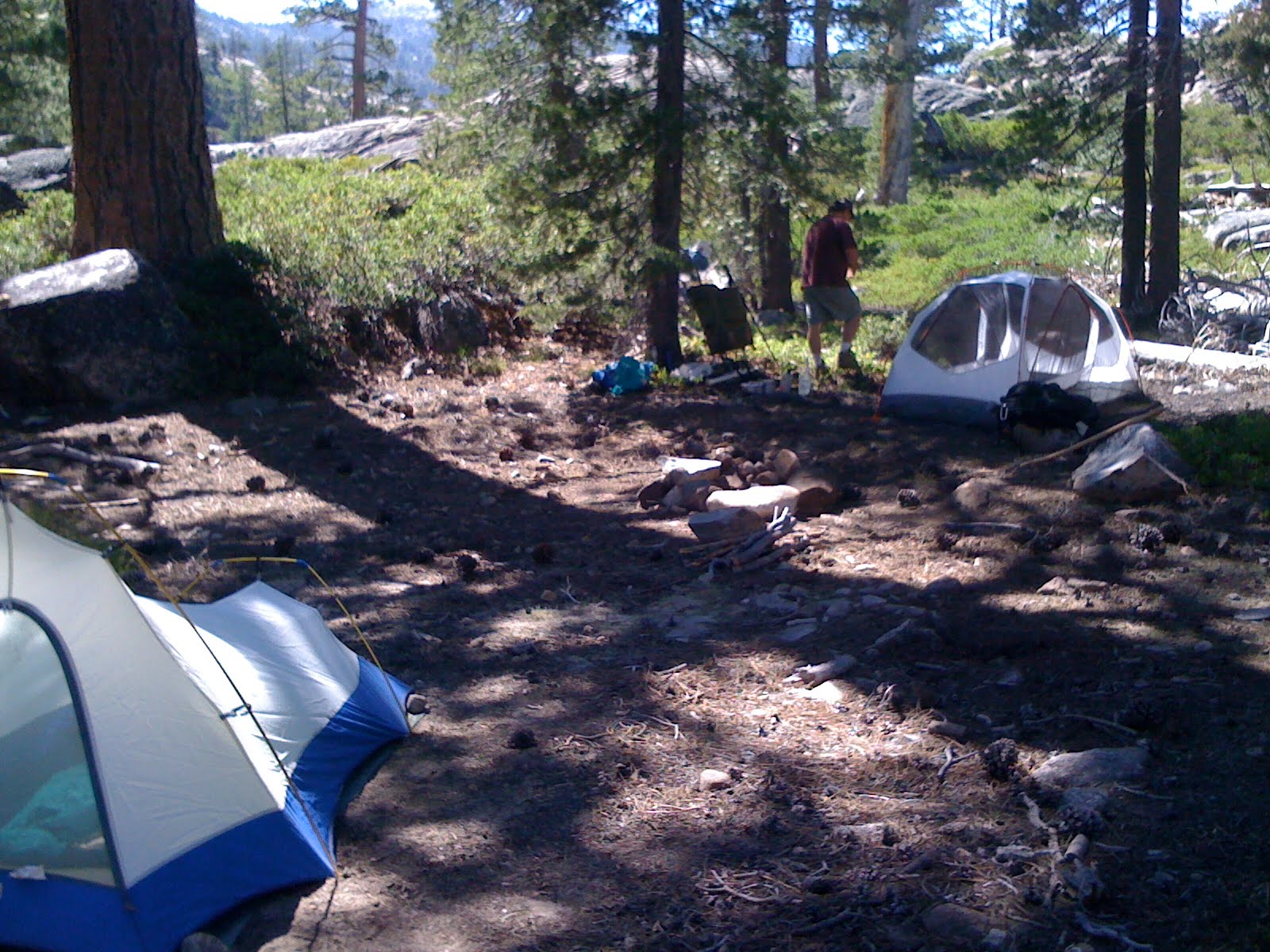
Citing "something like claustrophobia," my dad desperately sought an escape from his pack and, eventually, being upright altogether. We ended up back in the shady spot, where I quickly threw together a fire pit while Dad rested. It was nearly 3:30. We'd misfired, bitten off more than we could chew, and had to establish a camp nearly four-hundred feet from the river. It was our only option.
The shady spot, looking back toward the trail.
A clearing, converted for camping.
Days 2 and 3:
Suffice it to say, the trip didn't go according to plan. The details stuck to my father's memory couldn't compete with the reality we'd found. The fishing was, as you might imagine at this point, terrible. I landed two tiny ones on worms Tuesday morning. Other than that, there was nary a hit. My father's attempts with a fly pole went as swimmingly, and we felt thankful we'd packed in sufficient food just in case the fishing stunk.
Catching rays (and not fish).
Both Monday and Tuesday included naps, as well as pre-twilight bedtimes in preparation for Wednesday's uphill trek. The downtime proved vital for us both, as the exodus from the canyon seemed one huge climb after another--something we'd each failed to consider on our optimistic walk in. Somewhere near the location of the lightning strike, Dad reminded me it was his birthday. I realized that he's scripted fifty-four years' worth of evidence that suggest a young mind and stout heart might satisfy your soul, but they'll break your body.
The chair I made for the aged one.
Looking up, the only direction to go from here.
Safely home and rested, I can easily imagine that the older one gets, the more the pleasure is worth the pain. And so I'll think fondly of our misadventure, fish be damned.
But like a newly planted seed, he let the idea take roots. He fed it, nurtured it, and it quickly grew into a full-fledged plan. No longer dependent on weekends for free time, he conspired a mid-week, three-day trek into a section of the Mokelumne Wilderness. The distance, he said, was only about three miles, a perfect amount for someone eager to ease back into the lifestyle. The fishing on the north fork of the Mokelumne River, he told me, would be epic. Thirty years prior, he and his brother and their father could barely get their lines in the water. Each day they caught their limit before lunch, he recalled, and the river's meandering through granite and continual pooling gave anyone with a pole and a plan free reign on the trout.
He spread his excitement across the family like dandelion spores in the wind. Soon he was telling everyone about our return to the Mokelumne. He spent a good portion of my brother's wedding jawing with his brother and step-brother, beaming at his idea, his plan, and his new freedom. Most phone calls I made to him inevitably succumbed to preparations. Did I have utensils? he wondered; What food items did I plan to bring? The trip became a focal point between father and son; it was his pestering point, a countdown-worthy calendar item, the linchpin of my summer vacation that made all the trips before it merely warm-ups.
Day 1:
The trail head sits at Hermit Valley on Highway 4, just west of Ebbetts Pass. From there, it's four miles down the canyon to a spot named Monty Wolf's upper cabin site. The plan, my father said, was to go about three miles and stop near the inlet of a runoff creek labeled on our map.
We began at exactly 10:00 a.m. The trail skirted the north side of the river, then bent away from the water, dropping into a meadow formed by lightning strike and subsequent fire. The decrease in elevation seemed, at the time, undramatic, and my father continually plotted points on his mental and literal map. He pointed out hillsides where, according to him, the landscape would morph from thick trees to open granite. We trudged on through the timber, eager to find the place where the scenery opened and the river began falling into the aforementioned pools.
From time to time we rested, hydrated, and consulted the map. We ambled in and out of conversations, sharing both new stories and familiar memories, offering new analysis and previously unmentioned perspectives on the latter.
We crossed the Deer Creek inlet on a log and stopped for a meager lunch of dried fruit. We met two men--the only people we saw on the trip--who confirmed our location and the distance to Monty Wolf's upper cabin site. We passed beautiful campsites in the timber, both feeling headstrong and able, both certain we'd reach the vast rock slabs beyond.
About a mile below our lunch spot, we veered from the trail and hopped up and down rugged boulders in search of a place to camp. The cross-country search proved the killer. Dad grew increasingly tired; the heat of the sun and the fifty-plus pound pack grew more and more oppressive. We eventually rested in a shady spot, removed the bags, and walked toward the river hoping to find a suitable clearing.
Nothing.
We packed up again and started trudging down the trail, eventually stumbling upon the same two men, shirtless, drinking from tall cans, and enjoying the shade. "You made it," one said, confirming we had in fact walked all four miles to the upper cabin site. My father's heart sank. Exhausted, suffering from a self-diagnosed condition called "rubber legs," and feeling lightheaded in the altitude, he felt his plan had tumbled out of control. There were a few so-so camp spots, one man told us, but nothing like what we'd passed after lunch, a mile or so back up the hill. We turned and, in small steps, made our way back up the small incline to find a place to quit.
Citing "something like claustrophobia," my dad desperately sought an escape from his pack and, eventually, being upright altogether. We ended up back in the shady spot, where I quickly threw together a fire pit while Dad rested. It was nearly 3:30. We'd misfired, bitten off more than we could chew, and had to establish a camp nearly four-hundred feet from the river. It was our only option.
Days 2 and 3:
Suffice it to say, the trip didn't go according to plan. The details stuck to my father's memory couldn't compete with the reality we'd found. The fishing was, as you might imagine at this point, terrible. I landed two tiny ones on worms Tuesday morning. Other than that, there was nary a hit. My father's attempts with a fly pole went as swimmingly, and we felt thankful we'd packed in sufficient food just in case the fishing stunk.
Both Monday and Tuesday included naps, as well as pre-twilight bedtimes in preparation for Wednesday's uphill trek. The downtime proved vital for us both, as the exodus from the canyon seemed one huge climb after another--something we'd each failed to consider on our optimistic walk in. Somewhere near the location of the lightning strike, Dad reminded me it was his birthday. I realized that he's scripted fifty-four years' worth of evidence that suggest a young mind and stout heart might satisfy your soul, but they'll break your body.
Safely home and rested, I can easily imagine that the older one gets, the more the pleasure is worth the pain. And so I'll think fondly of our misadventure, fish be damned.
Subscribe to:
Posts (Atom)